Was Your Resume Seen?

Updated: Sep 27
Your Resume Was Submitted. Was It Ever Seen?
Understanding the Job Application Process
One of my private Remote Career Intelligence clients recently applied for a position through Indeed. She was not stretching her qualifications. The employer asked for three years of experience in several areas. She had more than 20 years of direct experience doing the work. However, Indeed showed her she did not qualify. There was no separate application route through the employer's website. Everything pointed back to Indeed.
A few days earlier, I had been discussing something important with my private clients. Submitting an application and getting your qualifications in front of the right human are not always the same thing. I had also coached a client on what to do when a strong-fit opportunity deserved another step after applying. She researched the employer, identified an appropriate professional contact, and reached out. Within about an hour, the company asked her to send her resume and cover letter. About an hour later, she received an interview request.
During her first interview, the employer revealed something unexpected. They had never received her resume or cover letter from Indeed. She advanced to a second interview, then a third and final interview. This experience raises a much bigger question: How many separate things must work correctly between finding a job and getting reviewed by the person hiring? More than most applicants ever see.
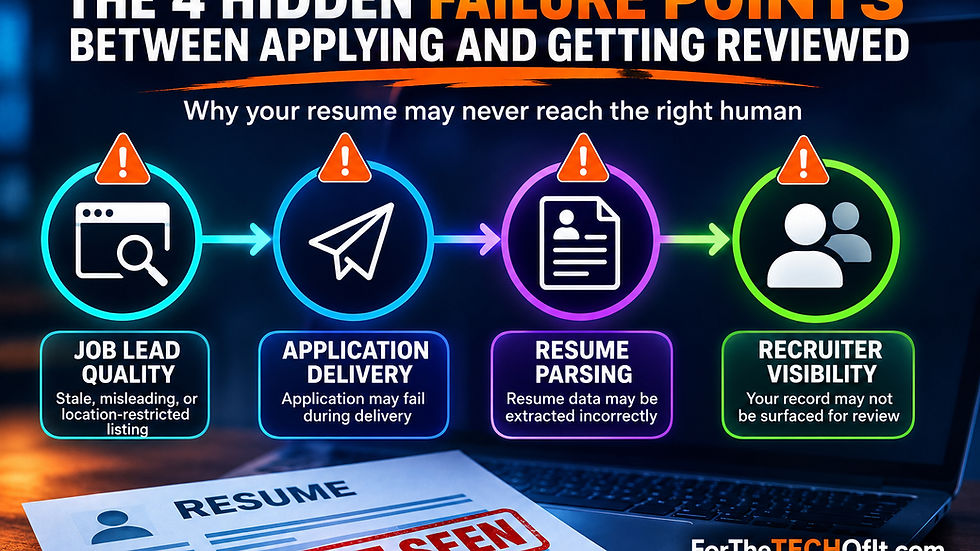
Your Application Has Four Major Failure Points
People often blame every strange rejection on “the ATS.” However, hiring technology is more complicated than one robot deciding whether you deserve an interview. There are at least four major layers to consider.
The Job Lead Itself
Is the employer legitimate? Is the opening current? Is the position still being filled? Is the location accurate? Is the job truly remote?
Application Delivery
Did your information and resume successfully travel from the place where you submitted them into the employer’s hiring system?
Resume Parsing
Did the hiring software correctly extract your employment history, dates, skills, education, contact information, and other qualifications?
Recruiter Visibility
Once your information reached the employer, did screening criteria, recruiter searches, filters, applicant volume, or other hiring tools surface your record for review?
These are separate problems. A perfect resume does not fix a dead job listing. Perfect keywords do not fix a failed application transfer. A delivered application does not guarantee accurate parsing. Accurate parsing does not guarantee recruiter visibility. This is why I approach remote job searching as an intelligence problem instead of an application-volume contest.
Start with Where You Found the Job
LinkedIn and Indeed primarily operate as job marketplaces and recruiting platforms. Applicant tracking systems, usually shortened to ATS, help employers receive, organize, search, evaluate, and manage applicants. Greenhouse and Lever are two examples. An employer's career page often connects directly to one of these systems. This distinction matters.
CareerPlug analyzed 2024 hiring activity from over 60,000 small businesses and more than 10 million applications for its 2025 Recruiting Metrics Report. Job boards generated 61.3% of applications but only 43.3% of hires. Company career pages produced only 13.1% of applications but accounted for 26.8% of hires. CareerPlug reports that applicants entering through company career pages were four times more likely to become hires than applicants coming from job boards. (CareerPlug)
This does not prove that applying directly always beats a job board. It does support a principle I have followed for a long time: Use job boards for research when appropriate. Then look for the employer’s original opening and direct hiring route. Where you apply matters.
The Application Flood Is Real
There is another reason source matters. Recruiters are handling far more applications. Greenhouse analyzed more than 640 million applications from over 6,000 companies between 2022 and 2025. Applications per job increased from 116 in 2022 to 244 in 2025, a 111% increase. Annual applications handled per recruiter increased from 146 to 746, a 412% increase. At the same time, the average number of recruiters per organization in the dataset dropped from 10.43 to 4.62, a 56% decline. (Greenhouse)
LinkedIn openly acknowledges the application-volume problem. The company now places daily and speed limits on Easy Apply. LinkedIn states that excessive application volume makes it harder for recruiters to identify genuine applicants among the noise. It encourages targeted, personalized applications rather than rapid mass applying. (LinkedIn) This tells us something important: An application does not enter an empty inbox. It enters a crowded recruiting system.
The LinkedIn Easy Apply Story I Found on Reddit
While researching this article, I found a Reddit post with an experience worth examining. The poster said they submitted 270 LinkedIn Easy Apply applications and received zero callbacks. Then a former coworker working in recruiting searched her company ATS for three specific skills the applicant possessed. According to the poster, the candidate did not appear. The applicant had already applied to the company months earlier. Their record existed. The poster says the recruiter opened the original resume and found the qualifications there, despite the applicant failing to surface through the ATS search. (Reddit)
That sounds alarming. It is also Reddit, and there are similar reports. I cannot verify the poster, employer, recruiter, ATS configuration, or explanation of what happened. I will not turn an anonymous Reddit account into a LinkedIn failure statistic. The value is the experience it describes. A person believes their original resume contained information that did not surface when the recruiter searched the structured applicant record. Now compare that story with what ATS providers themselves say about parsing later in this article.
LinkedIn Also Documents Application Delivery Failures
There is a second LinkedIn issue worth separating from parsing: delivery. LinkedIn Apply Connect links LinkedIn with participating employer applicant tracking systems. When someone submits through this type of integration, LinkedIn sends the application to the ATS. LinkedIn’s technical documentation includes formal error handling for failed deliveries.
Documented failure conditions include:
Missing required responses
Input validation problems
Closed job postings
Too many simultaneous requests
Signature mismatches
ATS-side transient errors
Other unknown errors
For several failure types, LinkedIn retries the application. Its integration instructions state the system attempts to resend an application six times after a non-success response. When applicable retries are exhausted, LinkedIn says the applicant receives an application-delivery-failure email. (Microsoft Learn)
This documentation applies to Apply Connect integrations. It does not establish a failure rate for all Easy Apply applications. It proves something narrower and important: Application delivery failure exists as a recognized technical condition between LinkedIn and connected employer systems.
In Some Integrations, More Than a PDF Moves Between Systems
Apply Connect also illustrates why application data deserves attention. LinkedIn describes the service as an integration between LinkedIn and an employer ATS. It supports the transfer of applications and skills-match data into the ATS. LinkedIn’s current release documentation states three skills pass to the ATS for each candidate through this integration. (Microsoft Learn)
Your application is therefore more than a file moving from one screen to another. Hiring technology works with candidate records, fields, answers, resume data, profile information, and employer-defined criteria. That becomes important when recruiters search applicant databases.
Then There Are Ghost Jobs
Sometimes your resume is not the primary problem. The opening is. Greenhouse surveyed 2,500 workers across the United States, United Kingdom, and Germany for its 2024 State of Job Hunting research. Three in five job seekers said they suspected they had encountered a ghost job. Greenhouse then compared those perceptions with activity on its own platform. In any given quarter, Greenhouse classified 18% to 22% of jobs posted on its platform as ghost jobs. (Greenhouse)
The issue has attracted government scrutiny. On July 14, 2026, the Texas Attorney General opened an investigation into LinkedIn over allegations involving fake or misleading job opportunities commonly called ghost jobs. This is an investigation. It is not a finding that LinkedIn committed wrongdoing. (Texas Attorney General)
This is one reason I research employers and openings before sharing remote opportunities. My Chatterbox Intel™ process looks beyond a title and salary. I research the employer, direct application route, remote status, location eligibility, posting status, and risk signals before deciding whether an opportunity deserves someone’s time.
If you are researching remote employers yourself, read my guide, “How I Tell a Real Remote Job From a Scam in Under Five Minutes.” Remote location rules deserve the same attention. “Remote” does not automatically mean every state, every country, or work from anywhere. My guide, “How to Quickly Read Location Eligibility in Remote Job Postings,” explains how to spot those restrictions before spending time on an application.
Now Look at Indeed
Indeed Apply is designed to remove friction from applications. Indeed’s current employer data shows indexed jobs worldwide with Indeed Apply receive 40% more application starts per job on average than indexed jobs without it. In the United States, Indeed reports jobs using Indeed Apply are 2.4 times more likely to result in a hire than jobs without Indeed Apply. Worldwide, 79% of applications submitted through Indeed are completed on mobile. The median completion time for an Indeed Apply application is 44 seconds. (Indeed)
Those numbers deserve context. Indeed Apply leads to hires. This is not an argument that people never get jobs through Indeed. It is evidence of an application process built for speed and reduced friction. Speed also feeds more applications into employer hiring workflows.
Indeed Employers Set Screening Requirements
This part matters when a platform tells someone they do not qualify. Indeed lets employers create screener questions covering areas such as experience, education, licensing, location, work authorization, availability, and travel. Employers designate certain prebuilt questions as required. Indeed’s current employer documentation says applicants whose answers fail those required criteria are automatically deprioritized and placed in the employer’s Rejected tab. The employer still has access to those applicants and is able to review or move them later. (Indeed)
So when an applicant sees a qualification result, it does not automatically mean a recruiter opened the resume and personally decided the person lacked experience. Screening logic exists before manual review. That brings me back to my client.
My Client Had More Than 20 Years of Experience
She applied through Indeed. The employer wanted roughly three years in several areas. She had more than 20 years of directly related experience. Indeed showed her she did not qualify. I do not know what produced that result. I do not have access to the employer’s screener configuration. I do not have Indeed’s internal application data. I will not guess.
What happened next is clearer. She used a research and follow-up strategy I had previously taught her. The employer asked her to send her materials directly. She interviewed within hours. According to my client, the interviewer said the company had never received her resume or cover letter from Indeed. That detail sent me into Indeed’s technical documentation.
Indeed Documents Delivery Failure Too
Indeed’s documentation for ATS partners explains how Indeed Apply sends candidate information into connected employer systems. Indeed sends application data as JSON. The application payload includes the raw resume file. (Indeed Documentation) Indeed expects the receiving system to return a successful HTTP response. A connection timeout, POST timeout, or invalid response counts as a failed delivery. Indeed retries the application. If delivery still fails after the final automatic retry, Indeed marks the application as a terminal failure. (Indeed Documentation)
Indeed also documents specific application-delivery errors, including:
Invalid or nonexistent job
Expired job
Duplicate application
Payload too large
Application unable to be saved (Indeed Documentation)
Indeed instructs ATS partners to monitor whether applications are arriving successfully. Its documentation says undelivered applications are automatically retried and retained for 60 days if delivery remains unsuccessful. Indeed specifically states it does not lose undelivered applications. That last sentence is important. I am not claiming Indeed lost my client’s application forever. I am saying her prospective employer reportedly had not received the documents when she reached them, and Indeed’s own technical documentation confirms delivery failures and delayed delivery are conditions its integration system addresses.
Other Indeed Users Report Similar Experiences
I also found a Reddit discussion from an Indeed user who said application confirmation emails arrived, yet several employers later told them the applications had not arrived. One recruiter reportedly thought the applicant was a strong match and moved the person into an interview after direct contact. A later commenter described following up on eight Indeed applications and being told by five employers that their applications had not arrived. (Reddit)
That is not an Indeed failure rate. It is anonymous community experience. I am including it because the reported experience resembles what my client described. The stronger evidence remains Indeed’s own documentation showing its ATS integration has explicit procedures for failed application delivery.
What Is an ATS?
Now we get to the additional layer. An applicant tracking system is hiring software used by employers to manage applicants and recruiting workflows. Jobscan released its newest ATS usage research on August 20, 2026. Its researchers reviewed the career pages of every Fortune 500 company. They detected an ATS at 487 of 500 companies, which is 97.4%. The remaining 13 might use proprietary systems Jobscan did not detect.
In a broader dataset covering more than 13,000 companies where Jobscan detected an ATS: 19.0% used Greenhouse, 17.5% used Workday, 15.6% used Lever, and 14.4% used iCIMS. (Jobscan) You do not need a list of every ATS provider in existence. You need to understand what happens after your resume enters one.
What Resume Parsing Means
Your resume starts as a document. Resume parsing attempts to turn information inside the document into structured applicant data. Instead of storing only Resume.pdf, a hiring system might extract information into separate fields: Name, Email, Location, Employer, Job title, Employment dates, Education, Skills. Recruiters then work with applicant records inside hiring systems. That is where another point of friction enters. Your original document might contain the information. A parsed field might not.
Greenhouse Tells Applicants Parsing Makes Mistakes
Greenhouse addresses this directly in its candidate documentation. The company states resume parsing is designed to save time but makes mistakes. Greenhouse tells applicants to review and edit their information before saving a profile and before submitting applications. (Greenhouse Support) Greenhouse now also offers AI-assisted Talent Matching for participating employers. The system analyzes candidate resume information against criteria selected by the employer and produces match information. Greenhouse states the feature does not automatically advance or reject applicants. Recruiters and hiring managers remain responsible for hiring decisions. Its documentation also says applicants whose resumes are not successfully analyzed because of certain formatting or technical issues are marked for manual review. (Greenhouse Support)
This is a useful example because two truths exist at the same time. Parsing errors are real. The myth of one universal robot automatically rejecting everyone below a secret score is not.
Workday Acknowledges Parsing Variability
Workday states resume parsing results vary based on resume format and word order. It recommends resumes without images or image-based styles for better results. (Workday Documentation) Again, this comes directly from the ATS provider. No viral statistic is required.
Lever Is Even More Direct
Lever’s developer documentation explains its parsing system attempts to extract fields such as name, headline, email, phone number, location, company, and links. Then Lever states something every applicant should understand: No information is guaranteed to be extracted. (Lever) That one sentence explains why I care so much about basic resume architecture.
Then I Found the “200 ATS Demos” Reddit Post
This was another community account worth reading carefully. An anonymous Reddit poster claimed they spent three years working in HR technology sales and sat through roughly 200 ATS demonstrations. The poster described sales demonstrations using a small collection of resumes already known to parse cleanly. They said complicated resume layouts produced far more extraction problems. The person also claimed Workday produced the worst parsing results they personally encountered and described one former customer experiencing missing skills data. (reddit.com)
I am not publishing those Workday claims as established fact. The identity is anonymous. The employment history is unverified. The 200-demo figure is unverified. The customer figures are unverified. Commenters also questioned whether the post was promotional. The anecdote still belongs in this discussion because it describes the same class of problem documented by Greenhouse, Workday, and Lever. I do not need Reddit to prove parsing errors exist. The ATS companies already acknowledge them.
The Employer Controls More Than People Realize
Another ATS myth needs to disappear. There is no single ATS robot running hiring across every company. Employers define their own requirements and workflows within the features their systems provide. Ashby provides a clear example. Its Criteria Evaluation system lets employers define job criteria. Ashby then parses applicant resumes and identifies each criterion as “meets,” “does not meet,” or “uncertain.” Ashby’s published bias audit says the system does not combine those individual results into one applicant-level score used for rank ordering. (Ashby)
Greenhouse Talent Matching also uses criteria selected by the employer. Recruiters still make the decision to advance or reject someone. (Greenhouse Support) This is why I do not tell job seekers they need some universal 70%, 75%, or 80% “ATS score.” No credible evidence supports one universal threshold across employers and ATS platforms. A score produced by a resume-scanning website is a score from that product. It is not a secret number pulled from every employer’s hiring system.
Recruiters Search These Systems Too
Parsing does not exist in isolation. Recruiters search their applicant databases. Jobscan’s 2026 ATS report says 76.4% of recruiters in its survey reported searching and ranking candidates by skills from the job description. Recruiters also reported searching by education, job titles, licenses, certifications, and years of experience. (Jobscan) Now the importance of accurate structured data becomes easier to see. If a recruiter searches a field or qualification and your information was not extracted correctly, another layer of friction enters the process. That does not mean you automatically disappear. It means clean data matters.
This Is Why I Keep ATS Resumes Boring
For online applications, your resume needs to work as a document and as data. Keep the architecture simple:
Use one column.
Use standard section headings.
Keep important experience in normal text.
Keep critical qualifications out of graphics.
Avoid text boxes for essential information.
Do not replace words such as phone or email with icons.
Keep dates consistent.
Review every field after an application system parses or autofills your resume.
Fix missing or incorrect information before submitting.
10. Use terminology from the job description when it truthfully describes your experience.
Your writing still needs to be strong. Your accomplishments still need evidence. Your resume still needs to sell your value to a human. The structure does not need decoration. General job seekers inside my online communities will find my free ATS resume resources in the Files section. Healthcare professionals have a separate Healthcare ATS resource and Healthcare Licensing and ROI Roadmap on my Products page. Free Remote Career Intelligence resources
The Strategy Starts Before Your Resume Ever Reaches an ATS
Resume optimization solves one part of the problem. A great application to a bad lead is still wasted effort. Before investing time in a position, I want job seekers checking:
Is the employer legitimate?
Is the opening still active?
Is this the employer’s original listing?
Is the job truly remote?
Does the employer hire where I live?
Does the compensation make sense?
Do my qualifications fit the actual requirements?
Is the application route still functioning?
That research sits at the front of my Chatterbox Intel™ process. It is also why I tell people to save worthwhile companies, not only expiring job links. For more on employer verification, read: How I Tell a Real Remote Job From a Scam in Under Five Minutes. For remote location rules, read: How to Quickly Read Location Eligibility in Remote Job Postings.
Then Think About What Happens After You Apply
This is one of the biggest pieces of job-search strategy I work on privately. For a weak match, move on. For a strong match, especially where your experience clearly meets the requirements, submitting the application does not always need to be your final action. Research the employer. Confirm the submission. Identify an appropriate professional contact when the opportunity warrants it. Follow up intelligently.
Do not message half the company. Do not hunt personal phone numbers. Do not send the same generic pitch to ten recruiters. One relevant professional contact with a clear reason for reaching out is different from mass outreach. My client from the beginning of this article understood the difference. She did not send another 100 applications. She recognized an abnormal result. She used the contact-research strategy we had discussed - that I only teach my clients. A company that reportedly had not received her application requested her resume. Within hours, she was interviewing.
This Is Where Private Job-Search Strategy Goes Further
I share a significant amount of Remote Career Intelligence for free. I do not publish every piece of my private client process. My 1:1 clients receive deeper strategy for high-value applications. That includes deciding which opportunities deserve extra effort, researching the right type of professional contact, choosing when outreach makes sense, and positioning the follow-up appropriately. The website or research tool is not the value. Knowing when to use it, who matters, what to say, and when to stop is the strategy. That is the kind of coaching my client was referring to when she told me she would have missed the opportunity without knowing her next step.
What This Does Not Mean
This article does not mean every rejection is an ATS problem. It does not mean LinkedIn Easy Apply never works. It does not mean Indeed fails to deliver every application. It does not mean every older job is a ghost job. It does not mean every resume parser destroys information. It does not mean every recruiter depends on keyword searches. It does not mean direct outreach guarantees an interview. Sometimes someone else is a stronger applicant. Sometimes you do not meet a requirement. Sometimes the employer changes direction. Sometimes the role closes. Sometimes your resume needs work.
The point is not to blame technology for every rejection. The point is to understand the full application path.
Your Job Search Is Bigger Than the Apply Button
Where you find the opportunity matters. Whether the employer is legitimate matters. Whether the opening is current matters. Where you apply matters. Whether the application reaches the employer matters. How your resume parses matters. How the employer configured its process matters. Recruiter workload matters. Your positioning matters. Your follow-up strategy matters. Your qualifications still matter most.
There is no single trick. There is a research process, an application process, and a visibility strategy. If you prefer the DIY route, start with the free resources in my communities and my Products library or in FILES in my online communities. If you want 1:1 Remote Career Intelligence support for your search, resume positioning, employer research, and application strategy, email remote@forthetechofit.com. Subject: Remote Career Strategy
Verified Sources
Greenhouse, The Hire Standard: 2026 Recruiting Benchmarks. Analysis of more than 640 million applications from more than 6,000 companies between 2022 and 2025. (Greenhouse)
CareerPlug, 2025 Recruiting Metrics Report. Analysis of 2024 hiring activity from more than 60,000 small businesses and more than 10 million applications. (CareerPlug)
Jobscan, 2026 Applicant Tracking System Usage Report, published August 20, 2026. Fortune 500 ATS audit and broader ATS dataset covering 13,130 companies. (Jobscan)
LinkedIn Help, Easy Apply Limits. LinkedIn explanation of application limits, application volume, automation, and targeted application guidance. (LinkedIn)
LinkedIn Apply Connect, Receive Job Applications. Official application delivery, retry, and error documentation for Apply Connect ATS integrations. (Microsoft Learn)
LinkedIn Apply Connect Overview and Release Notes. Official documentation describing LinkedIn and ATS integration, applicant data, and skills-match transfer. (Microsoft Learn)
Greenhouse, 2024 State of Job Hunting Report. Survey of 2,500 workers and Greenhouse platform data on ghost jobs. (Greenhouse)
Office of the Texas Attorney General, July 14, 2026. Investigation into allegations involving fake or misleading LinkedIn job opportunities. (Texas Attorney General)
Indeed, What Is Indeed Apply and How Does It Work?, updated 2026. Indeed Apply application and hiring metrics. (Indeed)
10. Indeed Employer FAQ and Screener Question Documentation, 2026. Employer-defined requirements, filtering, and applicant prioritization. (Indeed)
11. Indeed Partner Documentation, ATS Integration with Indeed Apply, updated July 1, 2026. Application transfer, raw resume data, delivery failures, retries, terminal failures, and integration monitoring. (Indeed Documentation)
12. Indeed Partner Documentation, Application Delivery Reference. Official application delivery error conditions. (Indeed Documentation)
13. Greenhouse, MyGreenhouse FAQ for Candidates. Official candidate guidance acknowledging resume-parsing errors. (Greenhouse Support)
14. Greenhouse, Talent Matching Documentation and FAQ, 2026. Employer-selected criteria, resume analysis, match information, manual review, and human hiring decisions. (Greenhouse Support)
15. Workday, Concept: Resume Parsing. Official documentation stating parsing results vary based on resume format and word order. (Workday Documentation)
16. Lever Developer Documentation. Official resume-parsing documentation stating extracted information is not guaranteed. (Lever)
17. Ashby, Criteria Evaluation Bias Audit. Documentation explaining employer-defined job criteria and resume-based evaluation. (Ashby)
Community Experience Sources
These accounts provide context only. They are not used as platform performance statistics.
Reddit, “A recruiter typed my exact skills into her ATS and I didn’t show up.” Anonymous account involving LinkedIn Easy Apply and recruiter ATS searching. (Reddit)
Reddit, “I spent 3 years in HR tech sales and I need to tell you why your ATS-optimized resume is probably the problem.” Anonymous account claiming roughly 200 ATS demonstrations. (reddit.com)
Reddit, “Indeed not passing on applications?” Community reports of employers reportedly not receiving submitted applications. (Reddit)


